The hoax as a weapon: this week’s aviation bomb threats and what they mean for every venue
The hoax as a weapon: this week’s aviation bomb threats and what they mean for every venue

No device was found on any aircraft. But hoaxes now achieve much of what an attack does: disruption, cost, fear and a view of how responders behave.
By TiNYg Editorial · 6 November 2026
On Monday 2 November 2026 a Wizz Air flight from London Luton to Sofia diverted to Budapest after a bomb threat. The next day at least seven European flights received threats, including two departing the UK, from Heathrow and from Manchester, which landed in Poland and Spain. Warsaw’s Modlin airport closed temporarily, and Italian Eurofighters escorted aircraft into Rome Fiumicino. A cruise ship was also targeted. No explosives were found. The UK government described the incidents as malicious hoax threats. Further fighter scrambles followed on 5 November.
An analyst at Osprey Flight Solutions called seven confirmed threats against flights in a single day exceptional. No one has yet been identified as responsible, and investigators have not established that the threats were coordinated.
Why this matters beyond aviation
The aviation wave is the most visible example of a broader pattern. The same week, refrigeration systems at supermarkets across seven European countries were sabotaged remotely (see article 11). Some analysts see both as part of a campaign of low-cost, deniable disruption; others caution that copycat behaviour and online subcultures can produce the same clusters. Either way, the security effect is the same.
A hoax achieves several things an attacker values:
1.Disruption at almost no cost. A message or call can ground aircraft, empty a stadium or close a shopping centre.
2.Reconnaissance. Every evacuation shows how a site responds: how long it takes, where people gather, where police deploy, which exits are used.
3.Erosion of trust. Repeated false alarms create fatigue among staff and the public, which slows the response when a threat is real.
4.Status. For young offenders in online communities, causing an evacuation is itself the reward (see article 4).
The ICCT has also warned that automated tools could be used to generate threats at a volume that overwhelms security services and businesses.
The professional view
The default reaction to a bomb threat, total evacuation, is not always the safest. UK protective security guidance has long favoured a structured assessment by a trained, named decision-maker, using the content and context of the threat, a search of the site, and a choice between evacuation, invacuation and continued operation. Evacuating several thousand people into an unsearched assembly point next to a road can create the very crowd an attacker wants.
Martyn’s Law will require qualifying premises to have procedures for evacuation and invacuation. Bomb threat handling should sit squarely within them.
What to do now
■Make sure every person who might take a threat (reception, switchboard, social media team, control room) has a bomb threat checklist and knows to whom to escalate.
■Nominate and train decision-makers; rehearse the decision, not only the evacuation.
■Search and vary evacuation assembly points; never use a single, predictable rally point.
■Log every threat and hoax and share with police, since clusters reveal campaigns.
■Prepare staff and public messaging that keeps confidence without detailing your procedures.
Sources
▪ ITV on hoax threats to UK flights (3 Nov 2026)
▪ The Aviationist: From drones to bomb hoaxes (5 Nov 2026)
▪ BusinessDay on Osprey assessment
The Conversation is TiNYg’s members’ blog. Members and premium partners are invited to respond to, extend or challenge this article. Get in touch to contribute.
The Conversation
 No. 1Martyn’s Law: the last six months before the clock starts
 No. 2After Leipzig: the drone threat is no longer theoretical
 No. 3Sabotage-for-hire: why your company is now on a hostile state’s target list
 No. 4Younger, faster, less ideological: the new radicalisation curve
 No. 5The chatbot in the attack cycle: what the evidence on AI and terrorism actually shows
 No. 6From Heaton Park to HAYI: the state-terror hybrid
 No. 7Cars and blades: why low-tech attacks remain the hardest to stop
 No. 8The executive as target: protective intelligence after Thompson
 No. 9Islamic State’s southern pipeline: why the Sahel is now Europe’s problem
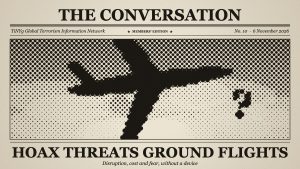 No. 10The hoax as a weapon: this week’s aviation bomb threats
 No. 11When the freezer is the target: cyber-physical convergence
 No. 12The insider for hire: how criminals and states now buy their way in