After Leipzig: the drone threat is no longer theoretical
After Leipzig: the drone threat is no longer theoretical

On 5 August 2026 an explosive-laden drone struck an aircraft at a German airport. Most private sites still have no means to detect a drone, and no legal right to stop one.
By TiNYg Editorial · 6 November 2026
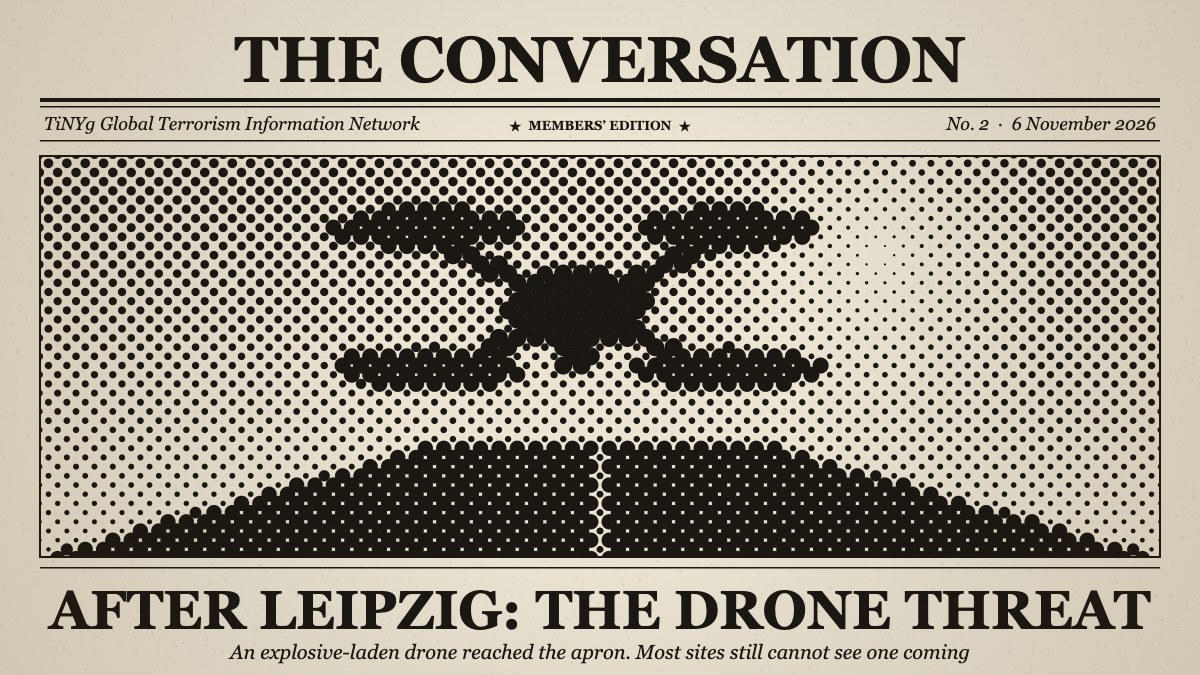
For a decade, the drone threat to crowded places was argued about in conference rooms. That debate ended at Leipzig/Halle airport. According to German reporting summarised by the European Council on Foreign Relations, CCTV shows a quadcopter, roughly the size of a microwave oven and carrying explosives, flying towards a parked Antonov cargo aircraft, striking a wing and falling to the tarmac, where a bus driver found it. The explosives did not detonate. It is the closest call yet to a drone-borne mass-casualty event in Europe.
The wider pattern
Leipzig sits on top of a rising baseline. The German air navigation service recorded 227 drone sightings by pilots in 2025, and 2026 is on track to exceed that. Copenhagen closed for four hours in September 2025; Brussels, Oslo and Munich have all suffered closures. A single evening’s disruption at Brussels has been estimated to cost around EUR 2 million. A June 2026 IISS research paper assessed it “highly likely” that Russia ran a drone campaign over Europe, largely in late 2025, with some flights possibly launched from shadow fleet vessels.
But security managers should resist reading this purely as a state problem. ECFR’s Ulrike Franke notes that, despite plots, no major terrorist drone attack has yet occurred in Europe, which she calls surprising given how available the technology is. The tactics, techniques and procedures developed in Ukraine (fibre-optic guided drones immune to jamming, cheap first-person-view platforms, interceptor drones) are diffusing to every kind of actor.
The three gaps that matter to private operators
1.Detection. Radio-frequency detection, the cheapest option, fails against drones that are pre-programmed, autonomous or fibre-guided. Radar struggles with small, slow targets and birds. Optical systems need line of sight. Every serious assessment ends in the same place: layered sensors, and humans to interpret them.
2.Authority. In most jurisdictions only police or the military may interfere with a drone in flight. Germany has amended its law to let the armed forces intercept in extreme cases, and France has created a route for private companies to provide drone protection for civilian infrastructure. The UK and US remain more restrictive for private operators. Jamming near an airport or a city centre can create more danger than it removes.
3.Procedure. Many venues have a drone policy that ends with “call the police”. It does not say who decides to stop an event, move a crowd under cover, or protect a VIP arrival while the police are on their way.
The professional view
Drone defence for most TiNYg members is not about buying an effector. It is about knowing your airspace (what normal looks like over your site), agreeing in advance with police who holds intervention authority, and building drone sightings into the same decision-making as a suspicious item or a hostile reconnaissance report. Hostile reconnaissance by drone, rather than attack by drone, is the more likely near-term use against private sites.
What to do now
■Add drone overflight to your site risk assessment and Martyn’s Law procedures as a named scenario.
■Brief control-room and front-of-house staff on what to record: time, direction, height, behaviour, operator location if visible.
■Agree a written escalation protocol with local police and, for larger events, with the airspace authority.
■Treat repeated overflights as possible hostile reconnaissance, and log them.
■Be sceptical of vendors: ask what their system cannot detect, and what it is lawful for you to do with it.
Sources
▪ ECFR: Buzzkill, How to defend Europe against drones (Aug 2026)
▪ Al Jazeera on Leipzig (Aug 2026)
The Conversation is TiNYg’s members’ blog. Members and premium partners are invited to respond to, extend or challenge this article. Get in touch to contribute.
The Conversation
 No. 1Martyn’s Law: the last six months before the clock starts
 No. 2After Leipzig: the drone threat is no longer theoretical
 No. 3Sabotage-for-hire: why your company is now on a hostile state’s target list
 No. 4Younger, faster, less ideological: the new radicalisation curve
 No. 5The chatbot in the attack cycle: what the evidence on AI and terrorism actually shows
 No. 6From Heaton Park to HAYI: the state-terror hybrid
 No. 7Cars and blades: why low-tech attacks remain the hardest to stop
 No. 8The executive as target: protective intelligence after Thompson
 No. 9Islamic State’s southern pipeline: why the Sahel is now Europe’s problem
 No. 10The hoax as a weapon: this week’s aviation bomb threats
 No. 11When the freezer is the target: cyber-physical convergence
 No. 12The insider for hire: how criminals and states now buy their way in